
What is a lead management system? A plain-English guide for Indian businesses (2026)
What a lead management system is, how it works step by step, the 8 features that matter, and how to choose a simple, affordable one for a small team in India.
21 October 2026 · LeadManagement Team
A lead management system is software that captures every enquiry your business receives, stores it in one place, assigns it to the right salesperson, reminds them to follow up, and tracks it until it becomes a customer or is closed as lost.
That’s it. Everything else (scoring, automation, dashboards) is a layer on top of those five jobs. If a tool doesn’t do those five jobs well, the extra features won’t save it.
This guide explains how a lead management system works, which features actually matter, and how to pick one without overpaying.
What is lead management?
Lead management is the process of tracking a potential customer from the moment they show interest (a form fill, a phone call, a WhatsApp message, a walk-in) to the moment they buy or drop out. A lead management system (sometimes called a lead management software, lead management tool, or LMS) is the software that runs that process for you.
Without a system, the process usually lives in a mix of WhatsApp chats, a shared Excel sheet, a diary, and someone’s memory. That works for the first 30–50 leads. After that, leads start slipping through the cracks, usually without anyone noticing.
How a lead management system works: the 5 stages
1. Capture
Every enquiry lands in one inbox, whatever its source: website forms, landing pages, IndiaMART or JustDial exports, Facebook lead forms, CSV uploads, or leads typed in by hand after a phone call. A good system tags each lead with its source, so you know which channel is actually paying off.
2. Assign (lead distribution)
The lead goes to a specific person: by territory, by product line, by round-robin, or by the manager’s choice. Unassigned leads are the most common reason enquiries go cold. If everyone owns a lead, nobody owns it.
3. Follow up
The salesperson calls, messages, or emails, logs what happened, and sets the next action date. The system reminds them when that date comes. This one feature, a daily follow-up queue, recovers more revenue for small teams than anything else.
4. Qualify and move through the pipeline
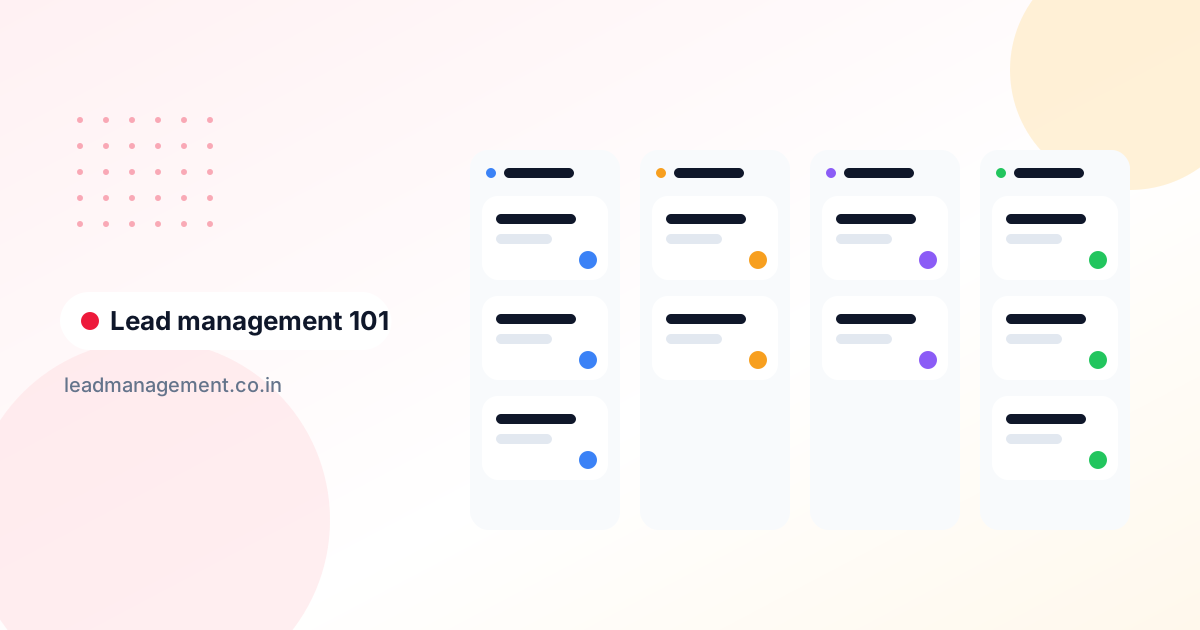
Leads move through stages, for example New → Contacted → Qualified → Proposal → Won / Lost. A kanban board makes this visual: each column is a stage and each card is a lead. If you want to qualify more rigorously, see our comparison of BANT vs MEDDIC vs GPCT.
5. Close and report
Won leads become customers (often with an order or invoice attached). Lost leads get a reason recorded. Reports then answer the questions that matter: How many leads did we get this month? From where? How many converted? Who on the team is converting best?
8 features a lead management system must have
| Feature | Why it matters |
|---|---|
| Multi-source lead capture | Web forms, CSV import, and API, so no enquiry lives outside the system |
| Lead source tracking | Shows which channel brings leads that actually close |
| Kanban pipeline / lead board | See every lead’s stage at a glance and drag to update |
| Follow-up reminders | Next-action dates plus a daily queue, so no lead goes cold |
| Lead assignment & team roles | Owner, manager, and executive views; leads routed to the right person |
| Custom fields & statuses | Fit the system to your sales process, not the other way round |
| Activity history | Every call, note, and status change on one timeline |
| Simple reports | Leads by source, stage, owner, and conversion rate |
For Indian businesses, add two more: INR pricing with GST invoices, and a system that works on a mobile phone, because that’s where most field sales teams live.
Lead management system vs CRM: are they the same?
They overlap heavily. A lead management system focuses on the pre-sale journey (capture, follow-up, conversion). A full CRM also covers post-sale work such as support tickets, account management, and marketing campaigns. For most small teams, a lead-focused CRM is the right starting point. We’ve written a full comparison of lead management vs CRM.
Who needs a lead management system?
You need one if any of these are true:
- You get more than 30 enquiries a month from more than one source
- More than one person handles leads
- You’ve ever found out a lead bought from a competitor because nobody called back
- You can’t answer “how many leads did we convert last month?” in under a minute
Common users in India include real estate agents, education and coaching institutes, IT and digital agencies, manufacturers and exporters, retail and showroom businesses, travel agencies, clinics, and B2B service firms.
Retail lead management
Retail and showroom businesses get walk-ins, phone calls, and WhatsApp enquiries, and most of them are never recorded. A simple lead management system lets the floor staff log each enquiry in 20 seconds (name, phone, product interest) and set a follow-up date. Even a 10% improvement in follow-up on walk-ins usually pays for the software within a month.
How to choose a lead management system (5 questions)
- Can my team learn it in one day? If it needs a 3-month implementation, it’s built for enterprises, not you.
- Is the pricing predictable? Watch for per-user pricing that triples when you add three salespeople.
- Does it work on mobile? Test it on a phone before you buy.
- Can I import my existing Excel or CSV leads? You should be live in a weekend. See our spreadsheet-to-CRM migration plan.
- Is there a free trial with no credit card? You should never pay before your team has used it for real.
If you’re comparing tools right now, our list of the best lead management software in India covers the main options and who each one suits.
Frequently asked questions
What is a lead management system in simple words?
It’s software that keeps every sales enquiry in one place, assigns it to a salesperson, reminds them to follow up, and tracks it until the lead buys or is closed as lost.
What is the difference between a lead and a customer?
A lead is someone who has shown interest but hasn’t bought yet. A customer has paid. Lead management is everything that happens between the two.
Is there a free lead management system?
Yes. Several tools offer free plans or free trials, but free plans usually limit users, leads, or features. Read our guide to free lead management software to see what you actually get for free.
How much does a lead management system cost in India?
Prices range from free plans to several thousand rupees per user per month for enterprise CRMs. Simple systems built for small teams, like LeadManagement, start at ₹499 per year with a 14-day free trial.
Can I use Excel as a lead management system?
For your first 30–50 leads, yes. Beyond that, Excel can’t send reminders, can’t handle multiple people editing safely, and can’t show you a live pipeline. That’s usually the point to switch.
The bottom line
A lead management system isn’t about fancy dashboards. It’s about making sure every enquiry gets a reply, and every reply gets a follow-up. Pick the simplest tool your team will actually use every day, import your leads this weekend, and measure the difference in 30 days.
Start a 14-day free trial of LeadManagement. No credit card, live in 60 seconds.